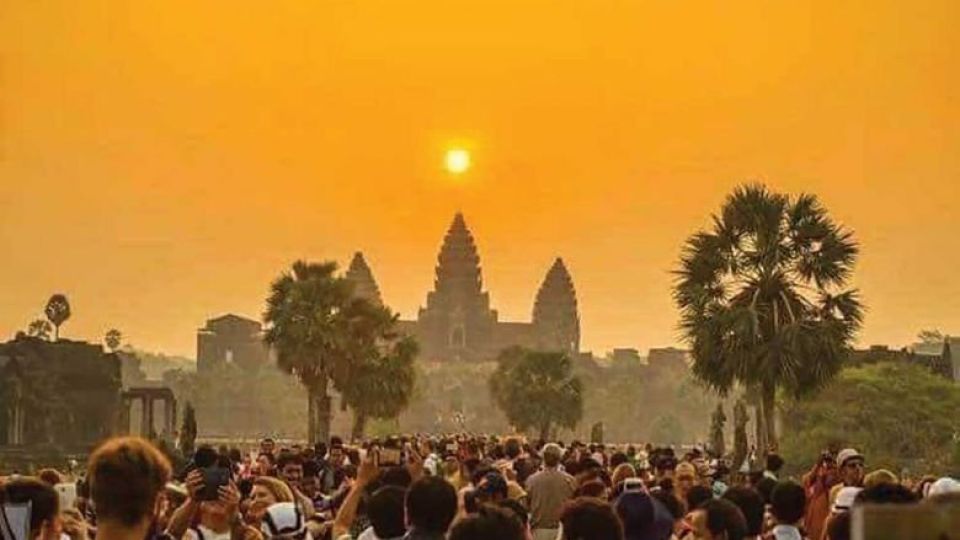
Angkor Wat stands as one of the most extraordinary architectural and spiritual achievements in human history, a vast temple complex rising from the plains of northwestern Cambodia near the modern city of Siem Reap, where lotus-filled moats reflect soaring sandstone towers and the rising sun ignites their silhouettes in gold, creating a spectacle that has become emblematic not only of a nation but of an entire civilization’s artistic and engineering genius; constructed in the early twelfth century during the reign of the Khmer king Suryavarman II, the temple was originally dedicated to the Hindu god Vishnu and functioned both as a state temple and as a monumental mausoleum, embodying the cosmic symbolism of Mount Meru, the mythical center of the universe in Hindu cosmology, through its quincunx of central towers rising above successive rectangular galleries and enclosed by a vast moat that measures nearly two hundred meters across, forming a protective and symbolic ocean around the sacred mountain at its core; the very scale of the complex is staggering, covering more than 160 hectares and constructed from millions of sandstone blocks quarried from the Kulen hills and transported via canals, each block meticulously carved and fitted without mortar in a testament to Khmer engineering precision, while the axial layout aligns with cardinal directions and celestial movements, suggesting a sophisticated understanding of astronomy and sacred geometry that scholars continue to study in awe; unlike many temples of its time, the complex faces west, a direction often associated with Vishnu and with death, reinforcing the theory that it was intended as a funerary monument for its king, and as visitors cross the long sandstone causeway over the moat, 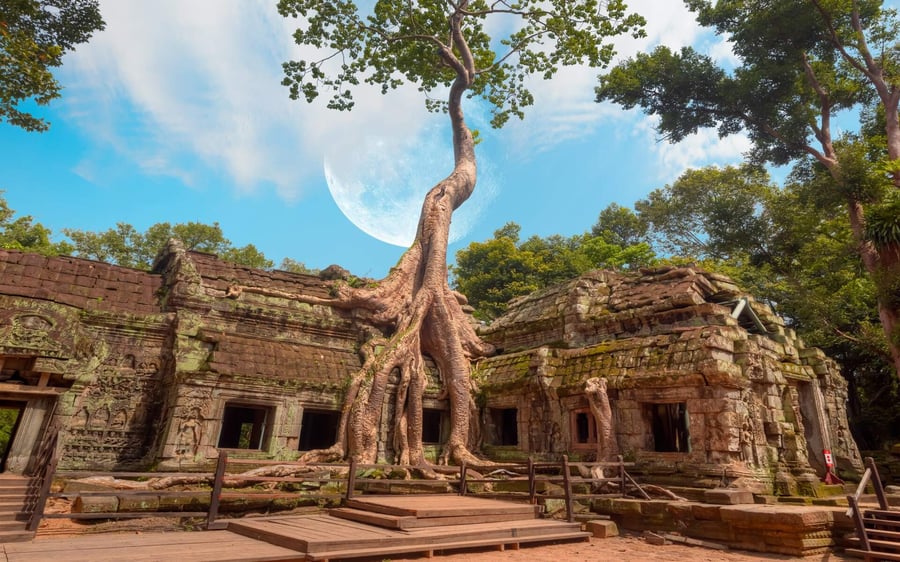 guarded by balustrades shaped like naga serpents, they symbolically traverse from the mortal world into a sacred cosmic realm, passing through gopuras, or monumental gateways, that frame progressively elevated courtyards culminating in the steep stairways leading to the central sanctuary, where once stood the principal image of Vishnu and where the spatial compression and vertical ascent create an overwhelming sense of transcendence; along the inner gallery walls stretch nearly a kilometer of bas-reliefs, among the most extensive and intricate narrative carvings in the world, depicting epic scenes from the Ramayana and Mahabharata, as well as historical processions of Suryavarman II’s court, celestial dancers known as apsaras, and the dramatic Churning of the Ocean of Milk in which gods and demons cooperate to extract the elixir of immortality, all rendered with astonishing detail, fluid movement, and expressive grace that communicate both religious devotion and imperial propaganda, intertwining myth and monarchy in stone; over centuries, the temple evolved from its original Hindu dedication into a Theravada Buddhist site, reflecting the religious transformations of the Khmer Empire, yet unlike many ancient capitals abandoned to jungle and time, it remained in continuous religious use, which contributed to its remarkable preservation, even as the political center of the empire shifted northward to Angkor Thom under later rulers and monumental structures such as Bayon with its enigmatic smiling faces and Ta Prohm with trees entwined around its ruins rose to prominence;
  despite periods of decline, regional conflict, and eventual French colonial “rediscovery” in the nineteenth century—when explorers and scholars helped introduce the complex to global audiences—local monks and communities had long continued to worship there, maintaining an unbroken spiritual thread that ties present-day Cambodia to its medieval heritage; architecturally, the temple exemplifies the classical Angkorian style at its zenith, with corbelled arches, cruciform terraces, and soaring prasats arranged in harmonious proportion, and the central tower reaching approximately sixty-five meters above ground level serves as both literal and symbolic apex, representing the peak of Mount Meru surrounded by subsidiary towers that echo the mountain’s lesser summits, while the concentric enclosures signify mountain ranges and the encircling moat stands for the cosmic ocean, turning the entire complex into a three-dimensional mandala through which pilgrims physically enact a metaphysical journey; the sandstone surfaces, once polished and perhaps painted in vivid colors now largely faded, capture light in shifting tones from dawn to dusk, so that at sunrise the eastern sky blushes behind the silhouette of the towers and at sunset the western orientation produces luminous reflections in the moat, creating a dialogue between architecture and environment that feels almost choreographed, especially during the equinoxes when solar alignment intensifies the sense of cosmic order embedded in the design; engineering innovations underpin this beauty, including sophisticated hydraulic systems that connected the temple to the broader Angkor water management network of reservoirs, canals, and barays, enabling agricultural abundance that sustained the vast urban population of the Khmer Empire,
  one of the preindustrial world’s largest cities, whose scale modern lidar surveys have revealed to be far more extensive than previously imagined, with grids of roads, embankments, and habitation zones radiating outward into what was once a thriving metropolis; culturally, the temple’s iconography offers invaluable insight into Khmer society, from depictions of courtly attire and military formations to scenes of everyday life interwoven with divine narratives, suggesting a worldview in which earthly kingship mirrored celestial order, and the apsara carvings—thousands of them, each with distinct hairstyles, jewelry, and gestures—testify to both aesthetic refinement and symbolic meaning, representing celestial beauty, fertility, and the grace of the divine feminine; the monument endured episodes of neglect and damage, particularly during periods of regional upheaval and in the twentieth century amid conflict, yet international conservation efforts, coordinated with Cambodian authorities and supported by global organizations, have worked meticulously to stabilize foundations, restore carvings, and manage tourism pressures, recognizing that the immense popularity of the site—drawing millions of visitors annually—poses challenges as well as opportunities, requiring careful balance between accessibility and preservation so that foot traffic, humidity, and environmental stress do not erode the delicate bas-reliefs and structural integrity that have survived nearly nine centuries; today, the temple appears on Cambodia’s national flag, a rare distinction that underscores its role as a symbol of identity and resilience, embodying both the grandeur of the Angkorian past and the enduring spirit of the Cambodian people, who view it not merely as an archaeological relic but as a living sacred space where monks chant, incense burns, and offerings are made, merging tourism and devotion in a complex contemporary reality; scholarly interpretations continue to evolve, debating the precise funerary functions of the westward orientation, the astronomical alignments encoded in its layout, and the socio-political messages embedded in its reliefs, while advances in digital mapping and conservation science reveal new details about construction techniques, quarry marks, and restoration histories, each discovery adding layers to an already rich narrative; to stand within the innermost sanctuary, ascending steep stairways that demand both physical effort and reverence, is to experience a deliberate choreography of ascent, where narrowing galleries and rising terraces focus attention upward toward the sky framed by stone, and where silence—punctuated perhaps by the rustle of saffron robes or the murmur of guides—invites contemplation of time’s vastness, for the temple has witnessed the rise and fall of empires, the encroachment and retreat of jungle,
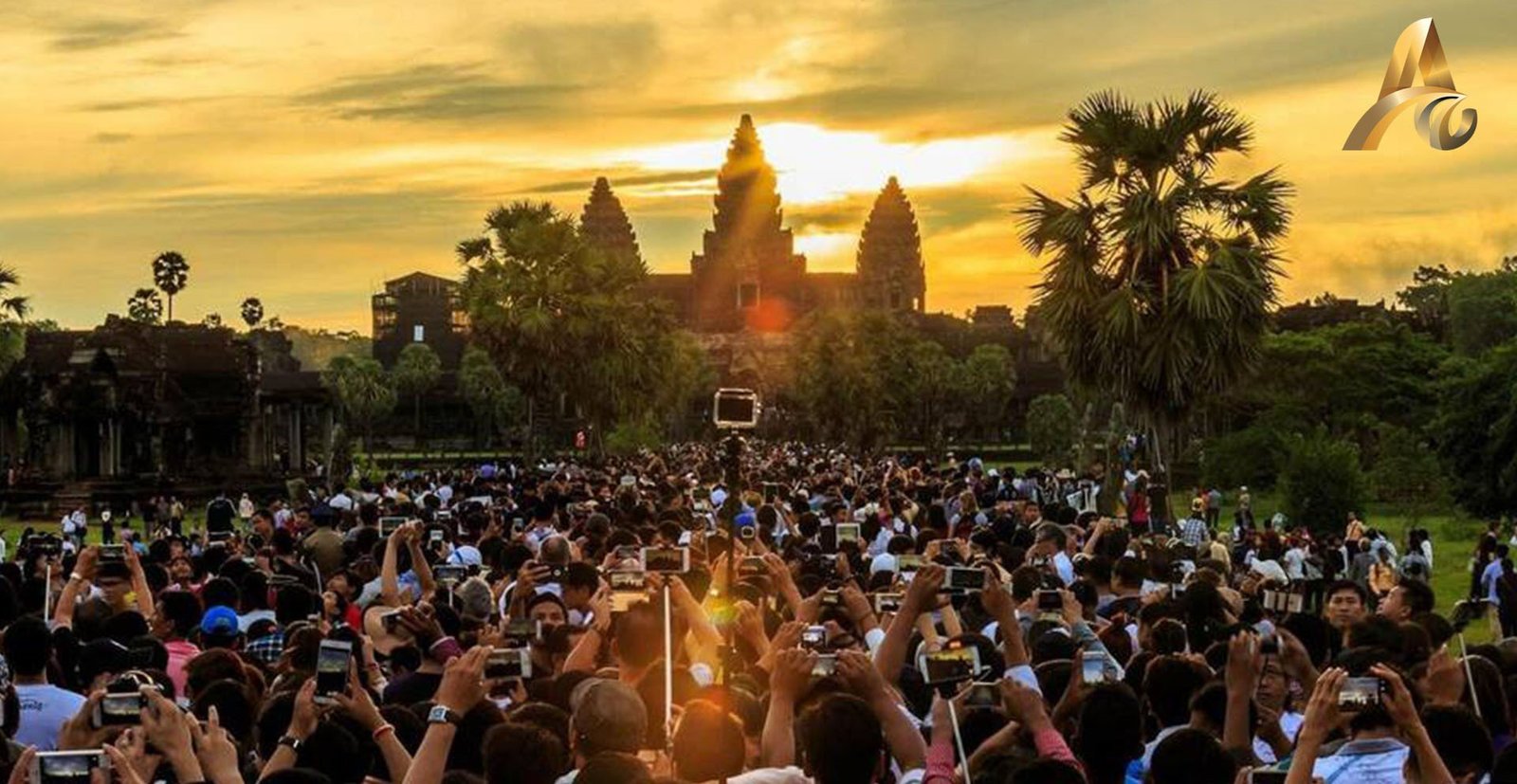
  colonial fascination, war and recovery, and the modern surge of global travel, yet remains anchored in its original cosmic vision; beyond its architectural and religious dimensions, the site also serves as a focal point for Cambodian cultural revival, inspiring dance traditions that emulate apsara poses, informing national art and literature, and anchoring educational narratives about heritage and pride, so that children grow up recognizing its towers as both historical inheritance and aspirational symbol; environmental factors, including monsoon rains and shifting groundwater levels, continue to test the resilience of its foundations, prompting ongoing research into sustainable preservation strategies that respect traditional materials while employing modern technology, such as laser scanning and structural analysis, to monitor microfractures and subsidence; the temple’s narrative reliefs function almost like a stone library, preserving mythological epics that link Southeast Asia to broader Indic cultural currents while simultaneously expressing distinctly Khmer interpretations, blending imported cosmology with local creativity in a synthesis that defines much of the region’s medieval art; as the first light of day spreads across the moat and tourists gather in hushed anticipation for the iconic sunrise, cameras poised yet voices subdued, the silhouette of the five towers emerges gradually from darkness, mirrored in still water like a vision suspended between earth and heaven, and in that moment the centuries collapse into a shared human wonder at what collective imagination and labor can achieve, reminding observers that this monument is not merely a relic but a testament to aspiration, devotion, and the profound capacity of architecture to embody a civilization’s worldview in enduring stone, a place where geometry becomes theology, where narrative becomes sculpture, and where landscape, water, and sky converge in harmonious dialogue, ensuring that the name Angkor Wat resonates across continents as a symbol of beauty, mystery, and the timeless dialogue between humanity and the sacred.