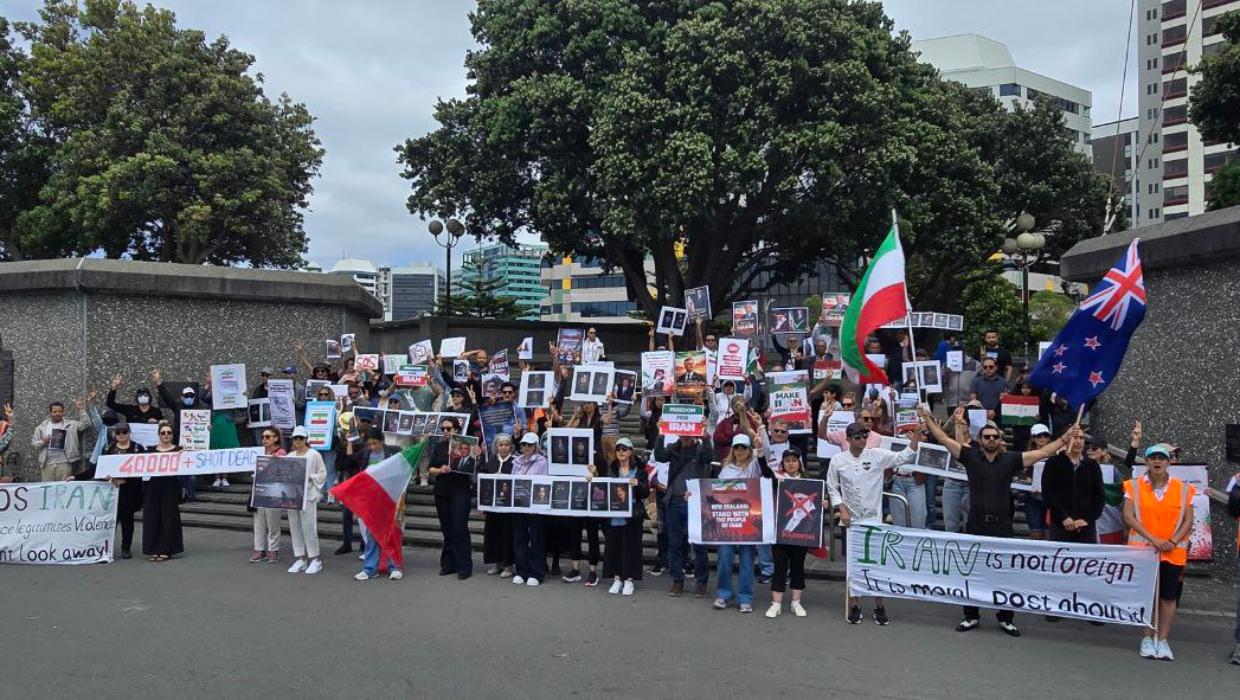
The US-Israel attack on Iran has split opinions at Parliament, and amongst New Zealanders. Some celebrated, and some admonished, the strikes. Political reporter Glenn McConnell looks at both sides, and what the fissure means for New Zealand.
When bombs rained down on her homeland, Samira Taghavi was overjoyed.
“It was the best day of my life,” Taghavi, a barrister who left her home after being tortured by the Iran Revolutionary Guard, told Stuff from her high rise office in Auckland City.
She said most Iranians felt relief over the weekend when the US and Israel launched air attacks against Iran. On Sunday, Taghavi joined other Iranians in Auckland on the streets, to celebrate the news that Iran’s 86-year-old Supreme Leader, Ali Khamenei, had been killed.
The joint American and Israeli military operation killed at least 200 people, according to the Iranian Red Crescent. About 800 other people were injured in Iran.

The air strikes targeted government departments, military bases, government leaders and a state television station. The strikes also hit a girls’ school, killing 153 people, including children, according to Iranian officials.
US President Donald Trump said his military bombed more than 100 targets across Iran.
Gulf emerges between Labour and National after US-Israel attacks
The killing of children was inexcusable, Labour leader Chris Hipkins said on Monday.
“There is never a justification for killing school children,” he said.
Hipkins spoke out strongly against the US-Israel attack. He called for New Zealand to stand up for international law, which, he said, the American and Israeli air strikes had clearly breached.
“It’s clear the international rules-based order is under a threat. It is not being followed in this situation, and New Zealand should be principled and calling for a return to the rules that we rely on,” he said.

Moments before Hipkins spoke to reporters, Prime Minister Christopher Luxon said he would support “any action” from New Zealand allies trying to stop Iran from acquiring nuclear weapons.
Hipkins said he was “somewhat shocked” to hear Luxon say that.
“Successive New Zealand governments have expressed significant concern about the Iranian regime, but that does not justify ‘any action’, particularly when it breaches international law,” Hipkins said.
Luxon said New Zealand was “not party or proxy” to intelligence held by the Americans and Israelis that might have influenced their decision to launch strikes, and so he wouldn’t pass judgement.
“All I can say, zooming out, is that as New Zealand we have had a long-standing commitment under successive governments that any actions that stop Iran from getting a nuclear weapon is a good thing,” Luxon said.

Clearly, however, the former and current prime ministers were not on the same page about where New Zealand stood, and had stood, on the issue of Iran.
Their comments showed how far the gulf was becoming between the country’s two major parties on issues of foreign policies. Both had, in recent years, shared very similar views on matters such as international law.
But with the Israel-Gaza War, air strikes on Iran, and the US abduction of Venezuelan President Nicolás Maduro, the parties have drifted apart. They used to speak about the importance of a “bipartisan” foreign policy, to give certainty to the world about where New Zealand would stand – no matter who was in charge.
That bipartisanship still exists when it comes to China, and the Pacific. But in the age of Trump 2.0, the Opposition has lashed the Government for not being more vocal about its concerns with what it says are clear and increasingly common breaches of international law. And on the issue of Palestine, the Opposition was united in calling for the recognition of a Palestinian state when the coalition was unable to agree on the issue.
The end of the rules-based order?
Most experts in international law and international relations argued the attacks were a breach, given neither side went to the UN Security Council for approval, and neither side faced an imminent threat of force from Iran.
Associate professor Nicholas Khoo, an Otago University lecturer in international security, said the attack was a breach of domestic sovereignty – and that should concern New Zealand.
“Ultimately, the United States is using force to change the status quo. And interestingly enough, the status quo was one where Iran’s regime actually, at least at face value, decided to engage in negotiations with the US. Certainly, most countries would not view that as the time to resort to using force,” Khoo said.
As a point of precedent, he said New Zealand had argued – “with most other countries” -against using force unless it was the last resort. This “ruled-based order”, he said, was important to small countries, such as New Zealand, which don’t have armies the size of the US and other great powers.
Former prime minister Helen Clark made a similar argument, telling Stuff, “The definition of what would be legal is, ‘Was there an imminent threat to the security of the United States and Israel?’ The answer to that is, clearly, ‘No’. Therefore, this becomes an act of aggression.”

American allies largely backed the US. Canada said it supported the attack, while Australia’s Anthony Albanese said he supported “the United States acting to prevent Iran from obtaining a nuclear weapon”.
A joint statement from Luxon and Foreign Minister Winston Peters initially said they “acknowledge” the reasons for bombing Iran, but held short of voicing support for that action. Luxon’s language then shifted by Monday afternoon, when he said his Government was committed to “any action” to stop Iran accessing nuclear weapons.
The original joint statement urged both sides to follow international law. It said: “We call for a resumption of negotiations and adherence to international law – and we urge the Iranian leadership to seek a negotiated solution that returns Iran to the community of nations.”
For Iranians in New Zealand, who had fled torture, brutality and fear of death in Iran, they said the US and Israel were protecting – not breaking – human rights.
Terror at home

In Wellington, Hanna Habibi organised a “dance for freedom” on Sunday. She danced at Frank Kitt’s Park, on the waterfront, with other Iranian Kiwis who hoped that reign of the Iran Revolutionary Guard Corps (IRGC) would soon be over.
Habibi hasn’t been able to visit her family in Iran for more than seven years. When she started openly criticising its government, which removed women’s rights and cracked down with deathly force on protesters, she knew she wouldn’t be able to return.
But when she saw Trump announce Ali Khamenei’s death, she thought maybe her dream of returning could come true.
“That is my dream,” she told Stuff, on Monday.

In 2022, Iran’s morality police beat 22-year-old Mahsa Amini to death, after arresting her for not wearing a headscarf in accordance with Iran’s religious law.
Habibi, like many Iranians – in Iran and across the globe – protested against the state. But the state responded with force.
In New Zealand, the following year, the Security Intelligence Service (NZ SIS) also raised concern that Iran was attempting to intimidate Iranians living in New Zealand.
“Globally, Iran has sought to silence dissenting Iranian voices in response to perceived threats to the Islamic Republic,” the SIS said. In New Zealand, it said it believed Iranian spies were “monitoring and reporting” on critics.
Habibi said she was living in “chosen exile”, afraid to return. She said the massacres of protesters, with upwards of 6500 – potentially tens of thousands – killed just this year in Iran, showed the risk.
She said it also showed why the strikes were justified. “There is a Responsibility to Protect,” Habibi said.
That is a commitment, made at the United Nations in 2005, for nations to intervene to stop genocide, war crimes and other crimes against humanity. When the UN passed this, it said the security council would continue to sign off on the use of “coercive measure”.
That hadn’t happened in this case, but Habibi said there was a clear need for international intervention.
“The Iranian people tried everything. We tried many years of pushing for reforms within the system,” she said.
“The Iranian people went to the streets, in their million. We thought that would be the end. But when they went to the streets, there was a massacre,” she said.
The cost of the attack was real. And she said the death of children was a tragedy. But she said the cost if the regime was to remain in power would be even greater.

In Auckland, Taghavi said she celebrated the death of Ali Khamenei, but still worried that his regime was in control.
“Most of my family are back home. I have a lot of friends back home. Most of my friends are in prison because there are political prisoners. And we have been told as of today, unfortunately, that all of the political prisoners have been moved from the current prison to an undisclosed location, and they have been blindfolded. So we are really, really worried about their safety,” she told Stuff, on Monday.
Having been a prisoner herself, she said the situation was dire. “I have been through anything you can think of,” she said. It also showed the urgency to continue attacks against the IRGC, she said.
But that would mean war, which she said that was the price of peace for Iran.
“We do know war is not good. But this is the only way that IRGC can be considered as gone. And once the IRGC is gone, we’re going to have peace back in the Middle East,” Taghavi predicted.